


In this tale from origin, a chorus of singing transforms coffee into a symbol of community and love.
BY TEWODROS BALCHA
BARISTA MAGAZINE ONLINE
Photos courtesy of Visit Oromia
Every December, much of the world turns toward familiar holiday soundtracks: choirs in tall churches, Frank Sinatra in cafés, the soft percussion of gifts being wrapped. But in Ethiopia, far from the winter lights of the north, another kind of carol rises—one without sleigh bells, English lyrics, or scripted harmonies.
It rises from washing channels.
It rises from drying beds.
It rises from the people who coax the world’s most celebrated coffees into being.
This year, as the global industry slides into its festive mood, I found myself asking whether the truest Christmas song for specialty coffee is not something we play through speakers, but something sung through the open air of the Ethiopian harvest.
And whether that song—the laughter, the rhythm, the human presence—has a measurable influence on quality.
It is a bold idea. But Ethiopia has never been afraid of bold ideas.

Where the Carols Truly Begin
At the Adola Washing Station—Kerchanshe’s flagship site known widely through its Vulture Coffee brand—the day’s work had already gained momentum when we arrived. We were scheduled for a technical briefing: density separation, washing cycles, soaking stages, moisture thresholds. The usual vocabulary of precision.
But precision wasn’t the first thing we heard.
From the side of the channel, a chorus rose. Young men clustered at the flotation tanks, paddles in hand, singing in melodies that moved with the water. Their laughter snapped rhythmically through the morning fog. Their voices, bouncing off tin roofs and concrete walls, folded seamlessly into the cadence of the pulsing channels.
It wasn’t a performance; it was a workflow.
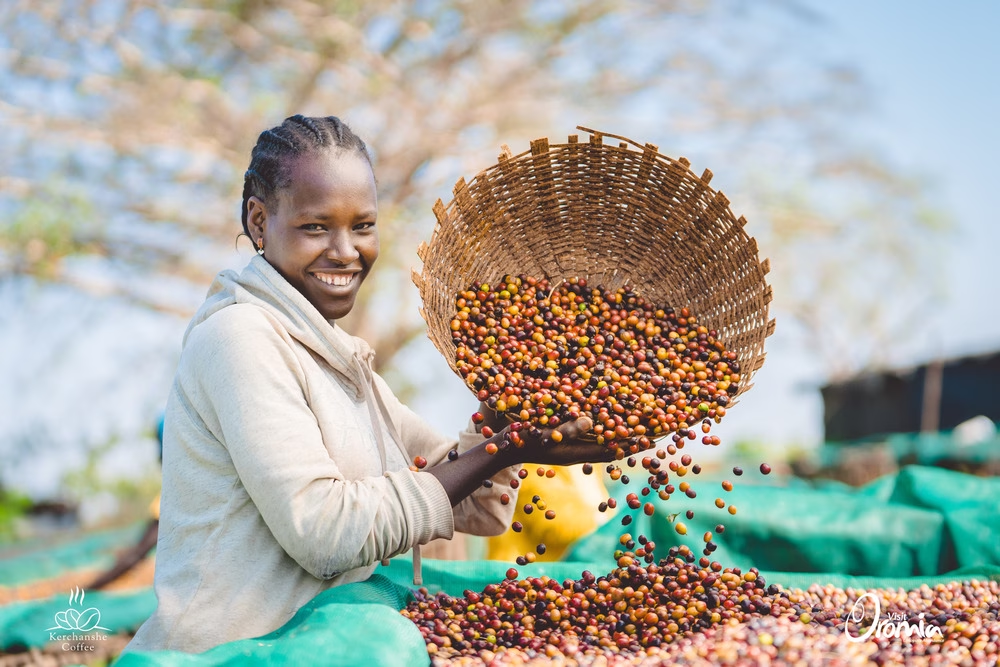
And just a few meters away—on the raised beds—women were already beginning their own rhythmic choreography. Raking, teasing apart clumps, adjusting the parchment with practiced gestures that seemed half-skill, half-instinct. Their conversations and occasional bursts of humour floated above the beds like threads in the same tapestry.
Sound here wasn’t decoration. It was part of the process.
And it made me wonder: Could this very sound be influencing quality?
The Touch That Blesses the Bean
When the songs softened, the tactile work took over.
Workers—many of them women—lifted back the sackcloth coverings and slid their hands under the rubber sheets with the kind of delicate force born only from repetition. The once-slumbering beans stirred, rolled, and shimmered in the morning light as rakes gently coaxed them into motion.
Running our palms across the parchment, the beans reacted like they were awake—dancing, tumbling, breathing. Watching the women work, I noticed how the body movements aligned with the drying rhythm: steady, intentional, and quietly confident. Not rushed. Not random. Almost meditative.

We talk often about the chemistry of drying, the physics of airflow, the technical necessity of uniform moisture migration. But these workers—touching the beans hundreds of times each morning—introduce a variable that industry literature rarely interrogates: intention.
In other industries, this would sound sentimental. In coffee, perhaps it’s overdue.
Because touch is a constant in Ethiopia’s processing culture. And unlike machine-assisted drying systems, human touch comes with energy—physical, emotional, cultural.
The question is whether the bean registers it.
A Scientific Provocation: Can Beans Absorb Joy?
This is where the idea turns daring. But festive seasons invite daring thoughts, and coffee—especially Ethiopian coffee—has always thrived on curiosity.
Standing at Adola, listening to the harmonies at the washing channels and the soft rake patterns on the beds, I remembered a controversial but persistent scientific anecdote: Dr. Masaru Emoto’s early-2000s experiments suggesting that water exposed to praise, affection, or positive intention could form more symmetrical, aesthetically pleasing crystals.
Scientifically repeatable? No. Dismissed entirely? Also no.
The experiments held onto the global imagination because they hinted at something counterintuitive yet oddly intuitive: that water might respond to the emotional environment around it.
Here is where it becomes interesting for coffee professionals:
Coffee beans, during processing, are deeply hygroscopic.
They absorb, release, expand, contract, and exchange moisture with their environment almost continuously.
They are, in other words, chemically open.
So the question becomes: If water is sensitive to vibration and emotional context—even hypothetically—what does that say about coffee parchment steeped in water, sound, and human presence for days on end?
Could beans, in their permeable state, absorb more than moisture?
Could they absorb vibration? Joy? Rhythm?
I’m not arguing that happiness can raise cupping scores by two points on command. I am, however, arguing that sound—especially rhythmic sound—has documented effects on plant biology. Studies on bioacoustics show responses in germination rates, stress signaling, and growth patterns based on frequency.
Coffee parchment is not a plant in the growing phase. But it is a living organic matrix responding constantly to its environment.
So perhaps the songs at the washing channels are not merely atmospheric; perhaps they are contributive.
A sonic terroir. A cultural fermentation. An invisible seasoning.
And perhaps Ethiopia has known this, intuitively, long before science ever cared to ask.
A Cup Filled With Carols
As baristas and roasters tune their playlists for the holiday season—curating “Holiday Blend” tracks, recalibrating seasonal menus, preparing for the end-of-year rush—I offer this invitation: When you brew a washed Ethiopian this December, pause.
Close your eyes, and listen for the Coffee Carols.
Listen for the voices at the washing channels—paddles striking water in rhythmic arcs.
Listen for the conversations and laughter of the women on the drying beds, guiding the beans with rakes and hands in patterns older than most roasting profiles.
Listen for the cultural presence behind the process.
And ask yourself, honestly:
Are you tasting a coffee? Or are you tasting the sonic and emotional imprint of a people?
Because before the global industry perfected its protocols, Ethiopia perfected its atmosphere.
And long before holiday playlists filled cafés, Ethiopia was already singing.
Not of winter, not of bells—but of the harvest.
The original Coffee Carols—unrecorded, unamplified, yet somehow always detectable in the cup.
A festive echo from origin itself.
Tewodros Balcha (Teddy) hails from Ethiopia, a coffeeland where the bean is life-vital. As a connector of Ethiopian and broader African coffee cultures, he shares the continent’s vibrant heritage with the world.

Subscribe and More!
As always, you can read Barista Magazine in paper by subscribing or ordering an issue.
Support Barista Magazine with a Membership.
Signup for our weekly newsletter.
Read the December 2025 + January 2026 Issue for free with our digital edition.