
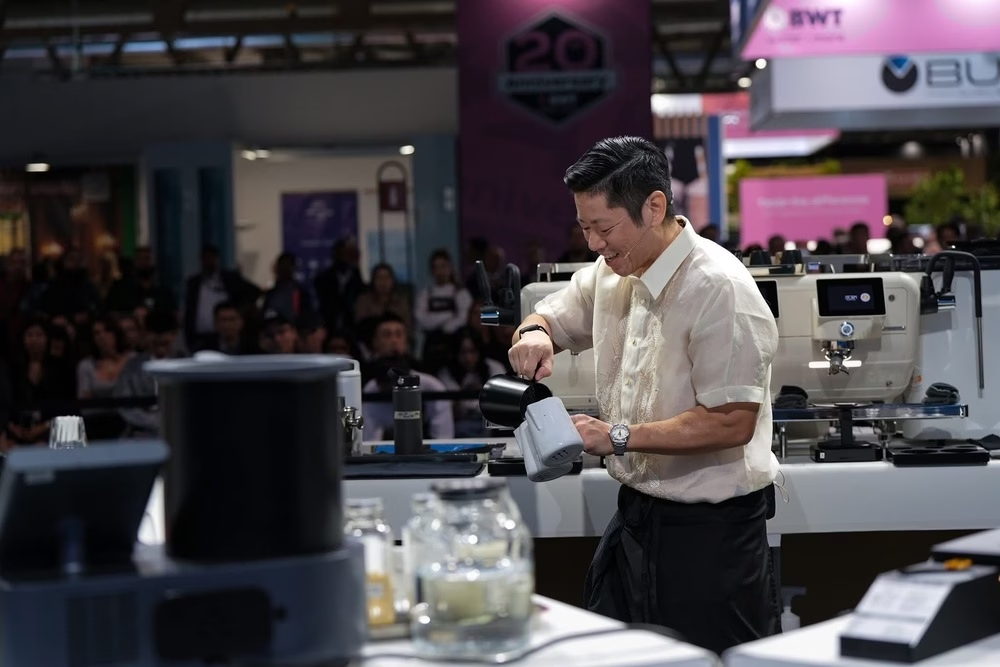

“It felt like carrying an entire nation’s coffee story onto the global stage,” the Filipino competitor says about his time at the World Barista Championship.
BY EMILY JOY MENESES
ONLINE EDITOR
Featured photo courtesy of World Coffee Competitions. All other photos courtesy of Michael Harris Conlin, unless otherwise noted.
Back in 2019, coffee competitor Michael Harris Conlin became the first from the Philippines to reach the semi-finals of the World Barista Championship (WBC) and finish in the top fifteen. This past autumn, he returned to the WBC in Milan, Italy, to once again champion Filipino coffee and the people behind it.
“Filipino coffee is not only about flavor—it’s about heritage, kindness, and human connection,” he told Barista Magazine. And this is exactly the type of energy Michael brings to both the competition stage and his everyday interactions: an energy of presence, authenticity, and love for his people.
During his 2025 WBC routine, Michael also introduced his latest invention, the Better Vessel: an espresso tool that’s quickly made headlines across the specialty-coffee world. We sat down with Michael to talk about coffee, the Better Vessel, and more—what inspires him, the significance of his time in Milan, and his hopes for himself and the coffee world as a whole.
Barista Magazine Online: Hi Michael! Thanks for taking the time to chat with us. Let’s start with the basics: Tell us about your start in coffee.
Michael: My coffee journey began in 2001. At the time, I was helping in our family’s abaca rope business, whose products were mainly exported to the United States, Europe, and the Middle East. I had always been a coffee lover, and starting my day with a freshly brewed cup of coffee was already part of my daily routine.
One day, one of our abaca fiber suppliers visited our office and brought with him a small batch of green coffee beans that he had grown alongside his abaca crops. That moment was my very first exposure to green coffee—and it sparked a deep curiosity in me. That single encounter led me into the world of roasting, wholesaling, and eventually the business of coffee itself.
Later that year, I founded Conlin Coffee World in the Philippines and in 2013, Henry & Sons, and over the years, coffee became far more than a business. It became my life’s mission: to build a platform where Filipino farmers, baristas, and communities could thrive together.
Coffee has always been a bridge for me—between people, between generations, and between possibility and purpose.

How was your experience at the World Barista Championship in 2019 and last year? You’re known for championing Philippine coffee—especially barako coffee—on the global stage. Why is this important to you?
Competing at the World Barista Championship in 2019 was one of the most defining moments of my life. Being the first Filipino to reach the semi-finals and finishing in the Top 15 felt like carrying an entire nation’s coffee story onto the global stage. It was an eye-opening experience. My goal that year was to bring Philippine coffee back to the global coffee spotlight..
Returning again in 2025 as Philippine National Champion was even more emotional, because it wasn’t just about me anymore. It was about showing the world that Philippine coffee, especially Liberica, can stand side by side with a Colombian Egenioded on the world stage. It was surreal that we got the highest scoring espresso during the first round.
Championing Philippine coffee, especially barako (Liberica), is deeply personal. Our farmers have endured decades of being overlooked. I want them to be seen, valued, and celebrated, as pioneers of something extraordinary.
Let’s hear about your invention, Better Vessel, which you used in your 2025 WBC routine. What exactly is it, and how did the idea for it come to you?
The Better Vessel is a tool we designed to improve espresso texture and flavor clarity by removing crema in an efficient way. My main goal in competition was to showcase Philippine Liberica, which is naturally very sweet and aromatic, but can also carry high levels of bitterness and umami. These elements can sometimes make the espresso taste unbalanced.
During one of my training sessions, my coach at the time, Federico Bolaños, suggested removing the crema to reduce unwanted flavors by pouring the espresso through a paper filter. It was an excellent idea, but it was too time-consuming and impractical for the fast-paced workflow required on the World Barista Championship stage.
That was when my son, Liam, made an important observation: Crema always rises to the top because it is made of CO2 and oils. He suggested that we create a vessel with concave inner walls, allowing the liquid espresso to flow through while encouraging the crema to cling to the sides.

From there, the idea quickly turned into a passion project. 3D design and 3D printing have always been one of my hobbies, so I began creating early prototypes, testing different shapes, angles, and internal curves that could separate crema more efficiently without sacrificing the espresso’s sweetness and body.
What started as a simple concept became nearly two years of continuous experimentation and revision—countless versions, small refinements, and real-world testing—until we finally arrived at the final Better Vessel design.
In the end, it became more than just a competition tool. It was a personal blend of family inspiration, engineering curiosity, and the desire to elevate the way we experience espresso.

How do you hope the Better Vessel will impact the café world?
My hope and dream for the Better Vessel is that it can help make espresso more welcoming and enjoyable for a wider audience. By removing the bitter, harsh, and astringent components that often come from crema, we can highlight the natural sweetness, clarity, and balance of espresso.
At the same time, the Better Vessel has the potential to reduce waste, which is a major issue in both cafés and home brewing. Baristas often rely on trial and error when dialing in espresso, and that process can lead to multiple wasted shots before achieving the ideal extraction.
For many people, espresso can feel intense or intimidating at first. But if cafés are able to serve cups that are smoother and more approachable, it becomes easier for new consumers to appreciate what specialty coffee truly has to offer. I believe this can open the door for more people to move beyond sugar-filled coffee drinks and begin enjoying espresso in its purest form.

With Better Vessel, baristas may be able to pull longer, higher-extraction shots with more confidence—maximizing sweetness while minimizing bitterness—without constantly discarding coffee during adjustments. This can make espresso preparation more efficient, more sustainable, and less costly over time.
Ultimately, my hope is that Better Vessel becomes a small but meaningful contribution to the daily craft of baristas, helping cafés serve espresso that is sweeter, cleaner, and more accessible, while also supporting a future where specialty coffee creates less waste and more enjoyment for everyone.
What do you want the world to know about Philippine coffee and the Philippines in general?
I want the world to discover the incredible potential of Philippine coffee—but even more than that, I want people to come to know the farmers, the culture, and the spirit behind every cup. The Philippines is not just a coffee origin; it is a coffee story waiting to be fully heard.
We grow remarkable coffee varieties such as Liberica (barako) and Excelsa, and while these varieties exist in other producing countries, the way they express themselves in the Philippines is deeply shaped by our unique terroir—our volcanic soil, tropical climate, diverse elevations, and the distinct traditions of our farming communities across the islands.
But what truly makes Philippine coffee special goes far beyond the beans. At the heart of it all are our farmers: resilient, hardworking, and deeply connected to the land. Many of them have endured decades of being overlooked in the global specialty market, yet they continue to cultivate coffee with pride, patience, and hope for a better future.

I also want the world to know that the Philippines is a place of extraordinary warmth and hospitality. Our culture is deeply welcoming, and because English is widely spoken as a second language, it is easy for visitors to connect with local communities, communicate with farmers, and experience the country in a very personal way.
Filipino coffee is not only about flavor—it’s about heritage, kindness, and human connection. When you drink Philippine coffee, you are also tasting the story of our people: their resilience, creativity, and their dream of being seen and valued on the world stage.
My hope is that as more people discover Philippine coffee, they will also help create a future where our farming communities can truly prosper, thrive, and take their rightful place in the global specialty coffee conversation.
Any exciting plans for the future?
There is so much ahead, and I feel very excited about what the next chapter holds. The final commercial model of the Better Vessel is scheduled for delivery in the first quarter of 2026. Alongside that, we are developing a new line of products under the Better Tools brand—focused on creating thoughtful solutions that make the lives of coffee lovers and professionals around the world better, from café workflows to home brewing experiences.
Beyond competition and product innovation, we remain deeply committed to the work happening at origin. Here in the Philippines, we continue to adopt and support coffee communities, helping improve quality, strengthen sustainability, and ensure that more of the world discovers not only our amazing coffees, but also the culture and people behind them.
My long-term mission is to build sustainable platforms where cafés can directly support farming communities—creating a cycle of dignity, empowerment, and shared success for everyone in the value chain. Ultimately, I want it to leave a legacy of kindness, courage, and connection.

Any last thoughts you’d like to share?
Only this: Coffee has always been about more than the cup.
It is about people: our farmers, our baristas, our communities. It is about stories of resilience, heritage, and hope. It is about innovation that elevates the experience, and kindness that strengthens the connections behind every drink.
And I truly believe the Filipino coffee community is entering a new chapter—one where we are not just participants, but leaders sharing our culture, our coffees, and our heart with the world. Together, we are building a beautiful coffee future.

Subscribe and More!
As always, you can read Barista Magazine in paper by subscribing or ordering an issue.
Support Barista Magazine with a Membership.
Signup for our weekly newsletter.
Read the February + March 2026 Issue for free with our digital edition.
For free access to more than five years’ worth of issues, visit our digital edition archives here.